From the hairpins of Stelvio to the cobblestones of Prague — Spain, Sardinia, Italy, the Swiss Alps, Austria, and France.
Moto Adventura guided tours through Spain's dramatic interior and coast — Roman ruins, hilltop pueblos blancos, medieval paradors, and the Mediterranean from above.
One of Spain's most dramatic riding roads — a switchback coastal highway with a Roman-arched viaduct clinging to the cliffs above turquoise Mediterranean water. The Cabo de Gata Natural Park protects the most arid coastline in Europe.
Joe in his Red Bull/KiNi race jacket and Kathy in Alpinestars at a coastal mirador — the winding road they just came down visible far below, Mediterranean stretching to the horizon.
A classic blue Vespa on a lamplit city street. In Andalusian cities, the evening belongs to those who walk slowly — and the scooter is the city's native creature.
A sweeping gold arch installation transforms Málaga's famous pedestrian boulevard. Calle Larios has been the beating heart of the city since 1891 — at festival time, it becomes one of the most photographed streets in Spain.
A bride and groom steal a quiet moment against the massive limestone walls of Málaga's cathedral — nicknamed La Manquita ("the one-armed lady") because one of its towers was never completed.
A bold lithograph of pitcher, fish, and sea urchin — Picasso's native Mediterranean rendered in pure graphic black and white. The museum occupies the 16th-century Buenavista Palace, just steps from his birthplace.
A shaded plaza in one of Andalusia's most beautiful pueblos blancos. The Plaza de Santa Ana plaque marks a square where time seems to stop — white walls, geraniums, and the unhurried pace that defines village life in the Sierra de Grazalema.
Resting in a centuries-old vaulted stone hall. Spain's state-run paradors occupy medieval castles, convents, and palaces — the gear says motorcycle tour, the walls say the 12th century.
Anchovy and avocado on monogrammed parador china. Spain's paradors don't just offer historic rooms — their kitchens draw from centuries of regional culinary tradition, presented with quiet elegance.
Pink and orange light ignites the limestone ridges behind the Costa Blanca. These mountains rise from sea level to over 1,500 meters — carved by rivers, ancient reefs, and millions of years of Mediterranean weather.
Cobblestones and candlelight — the old quarter of Altea rewards those who wander after dark. Whitewashed walls glow amber above the Mediterranean in one of the Costa Blanca's most beautiful villages.
Fascinator hats and fine dresses on cobblestones — a Spanish village wedding in full tradition. Celebrations here spill into the streets, involve the whole village, and last until dawn.
The group gathers beneath a Roman stone arch near the Tajo reservoir in Extremadura — where 2,000-year-old structures still frame the landscape. Eight riders, one ancient doorway that has witnessed two millennia of travelers passing through.
Another angle reveals the Tajo reservoir stretching behind the ancient stonework — a reminder that Extremadura's rivers powered both Roman aqueducts and modern hydroelectric dams.
Helmet in hand on the steep stone channels of Candelario — a mountain village famous for its unique street system designed to funnel water and cattle downhill, unchanged since the Middle Ages.
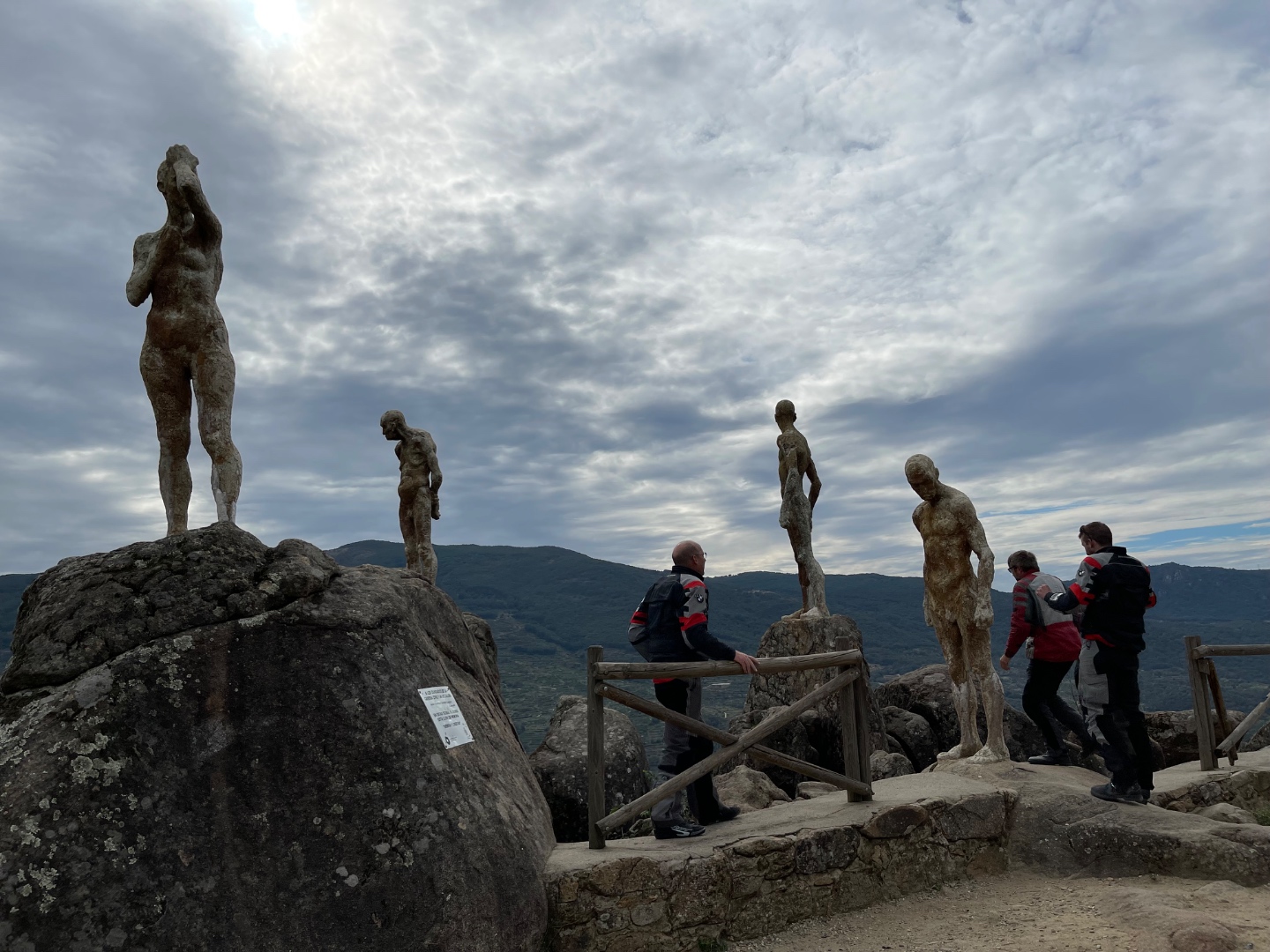
Bronze figures perch on the massive granite boulders of the Ávila plateau — a surreal outdoor sculpture installation where art and ancient geology merge on the high Castilian meseta.
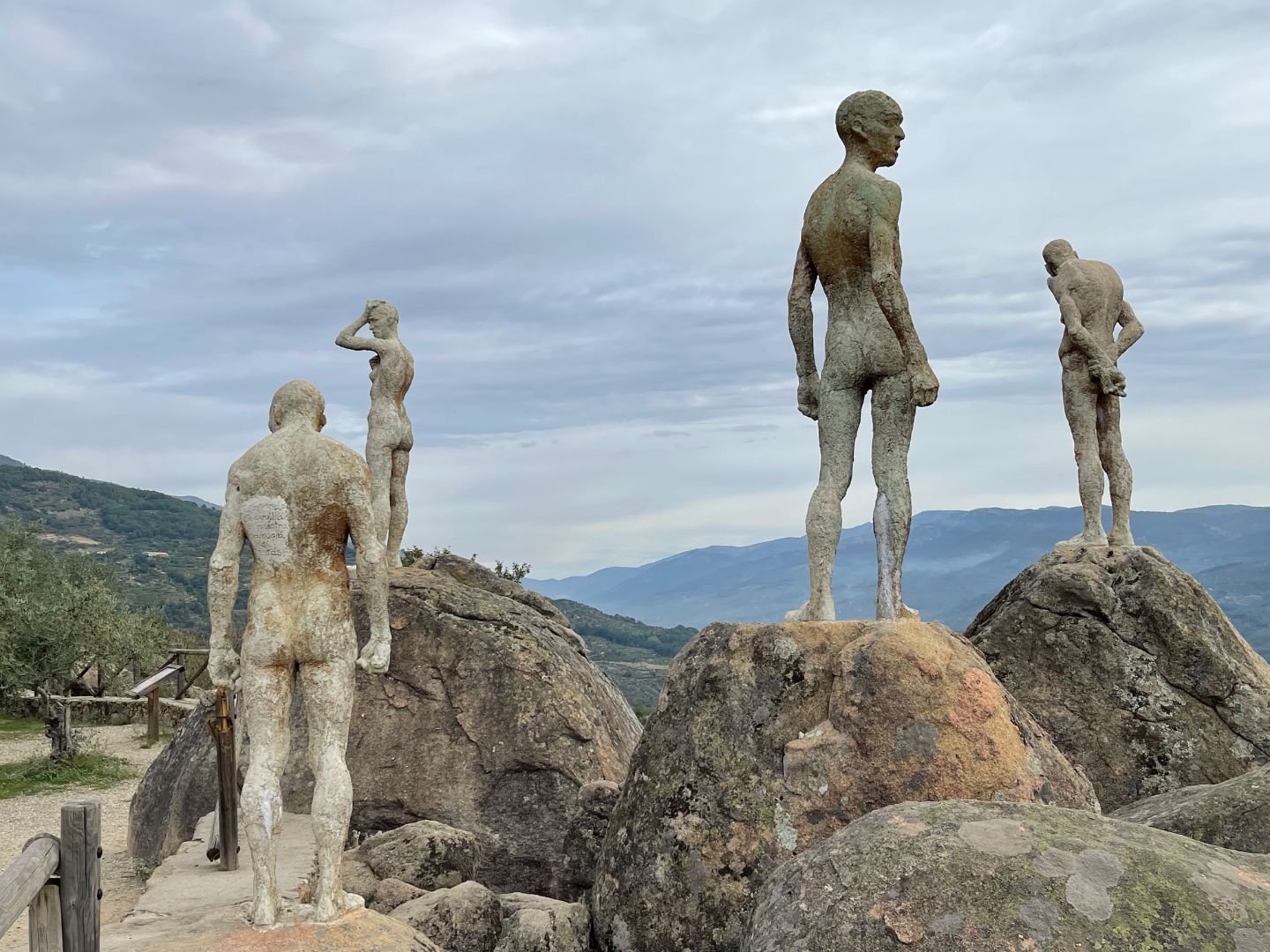
From a different angle the scale becomes clear — the granite tors are massive natural formations, and the sculptures seem to grow organically from the stone itself under the enormous Castilian sky.
Nine travelers take their seats in one of Europe's best-preserved Roman theaters, built in 16–15 BC under Marcus Agrippa's orders. Mérida — ancient Emerita Augusta — was once the capital of the Roman province of Lusitania.
Toledo's cathedral tower glows gold against the blue-hour sky — a stork's nest crowning the medieval rampart. For over a thousand years this city was a crossroads of Christian, Muslim, and Jewish cultures.
The Mudéjar-arched cloister of the Parador de Mérida ignites under a spectacular sunset. This 18th-century convent — built on Roman temple foundations — blends Christian and Moorish traditions in one breathtaking courtyard.
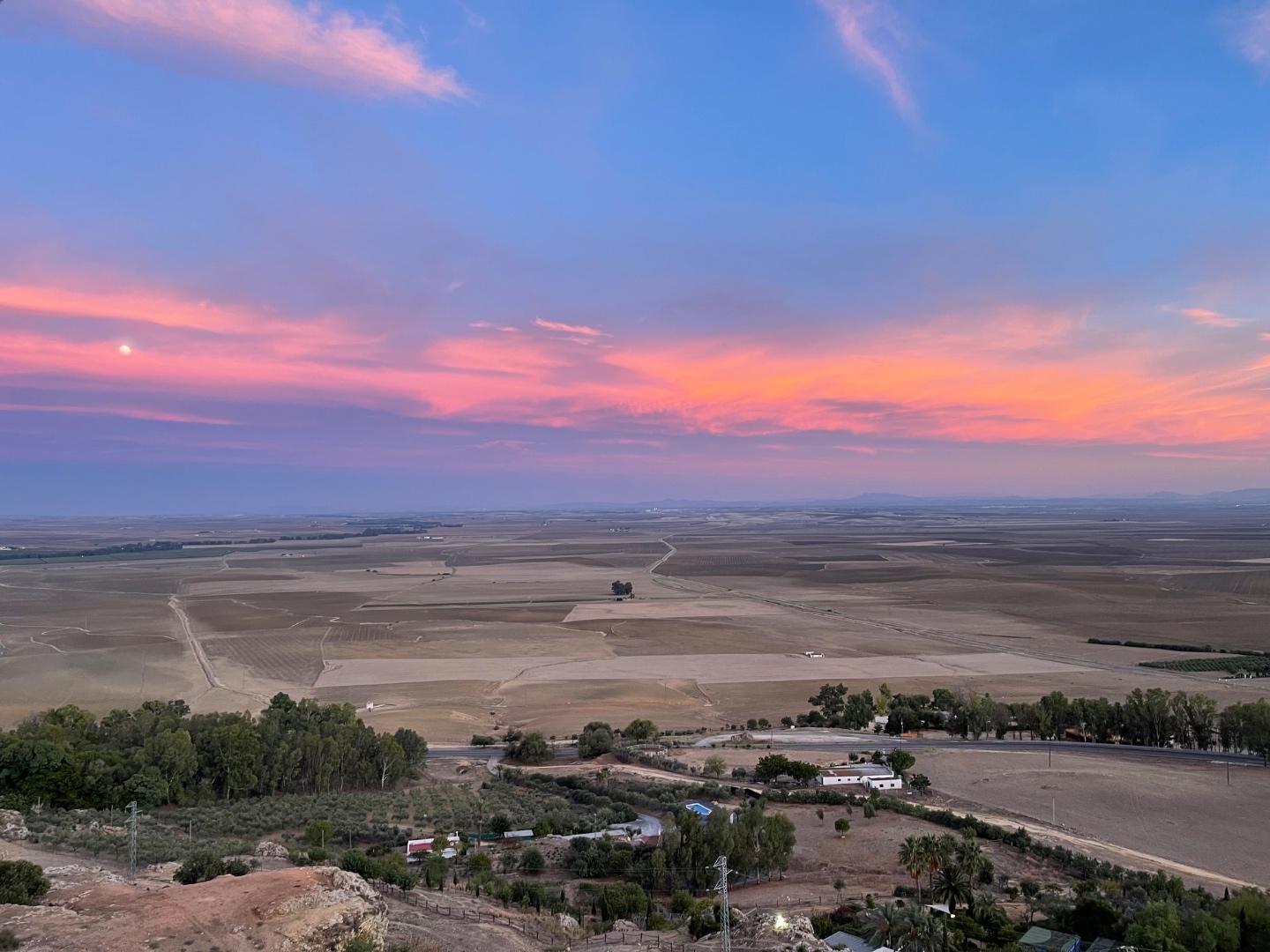
The moon rises into a pink dusk over the vast Extremadura meseta — home to conquistadors, black Iberian pigs, and vast cork oak forests that stretch endlessly in every direction.
A baroque church tower cuts a dramatic silhouette against a deep orange sunset. Hundreds of towns across Andalusia look exactly like this at dusk — and every single one is worth stopping for.
"RECUERDE / HIELO / 30" — Remember: Ice, 30 km/h. These southern mountain passes offer some of the most dramatic riding in Europe but demand respect year-round. The Sierra Nevada summits exceed 3,400 meters.
Four BMW R1250GS bikes at a mirador above the clouds — the Sierra de las Nieves, a UNESCO Biosphere Reserve, offers sweeping views from the mountains all the way down to the Mediterranean coast.
Eight BMW R1250GS bikes parked at golden hour beneath the Catalonian flag. Cardona Castle — a 9th-century Carolingian fortress converted to a parador — commands a sweeping view across the Cardener valley.
The extraordinary serrated rock pinnacles of Montserrat rise above the green hillside — a geological formation so otherworldly that Wagner used it as inspiration for the mountain of the Holy Grail in Parsifal.
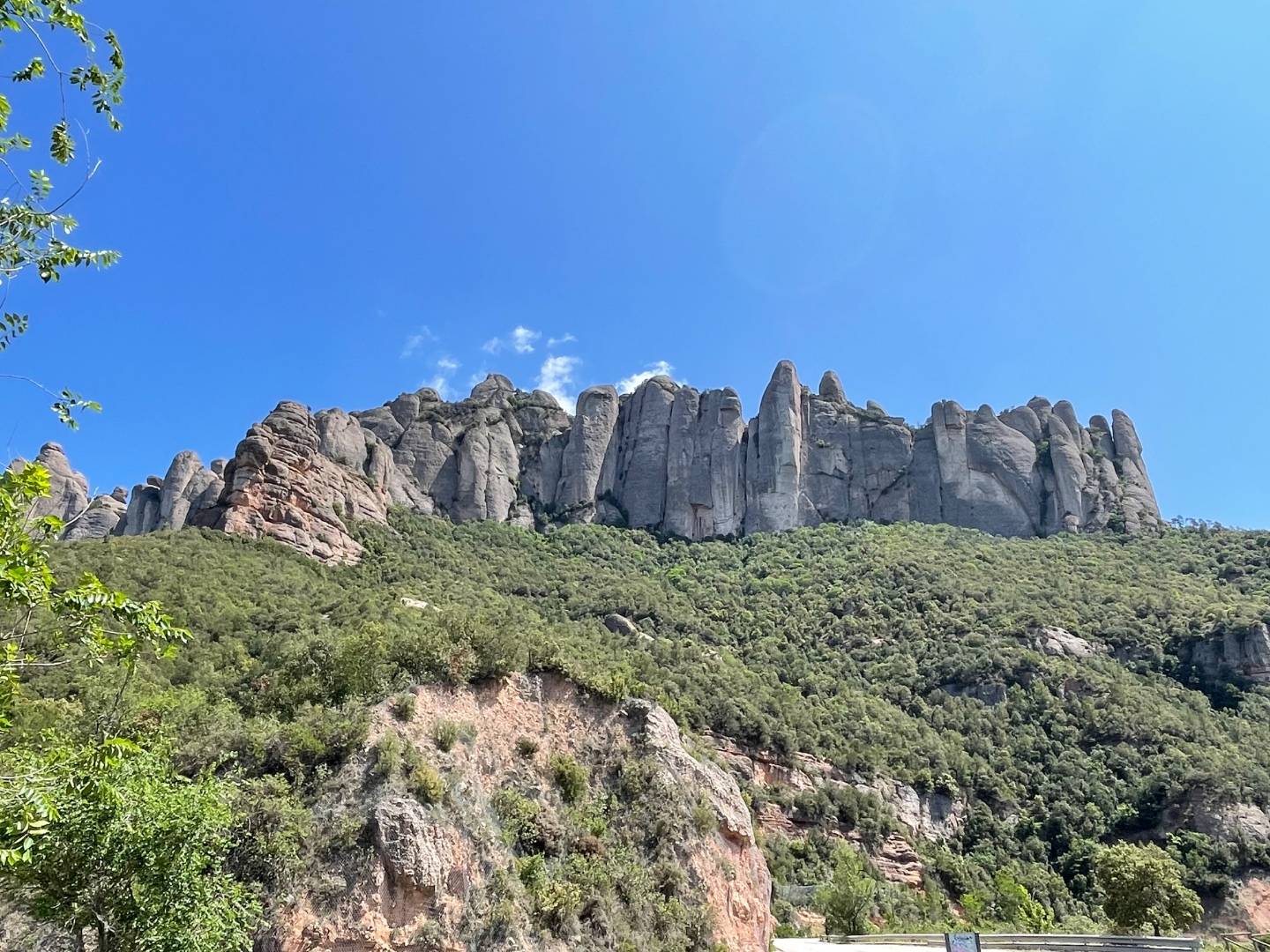
The approach road reveals the full scale of Montserrat's multi-peaked massif. The Benedictine monastery hidden within has been a pilgrimage site since the 12th century, home to the Black Madonna of Catalonia.
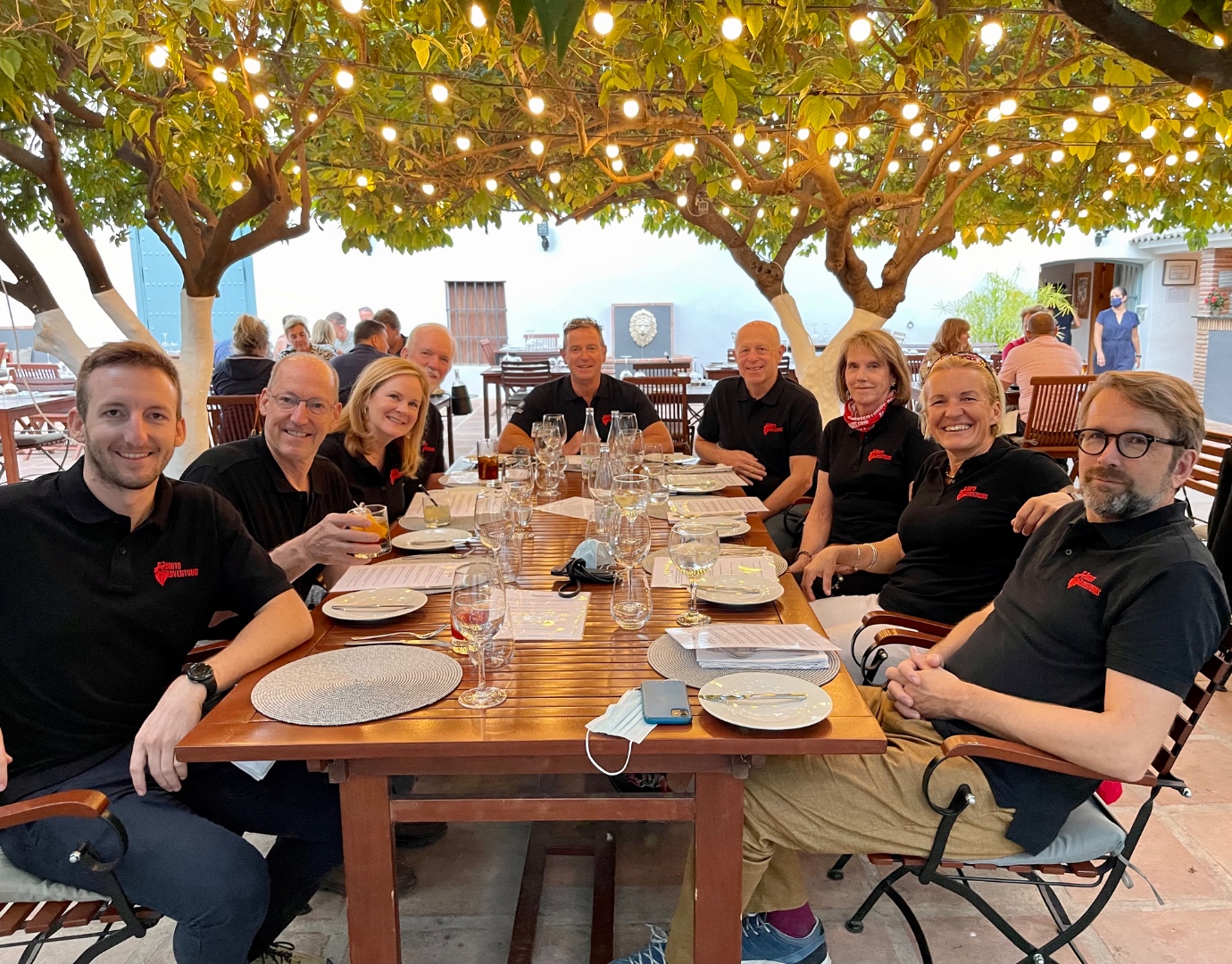
The Moto Adventura group gathers under string lights for an alfresco dinner — a nightly tradition where the ride stories are as good as the food. The red Moto Adventura logo on matching black shirts marks a tight-knit crew.
The MotoAdventours.com VW Crafter support van flanked by six fully-loaded BMW R1250GS Adventure bikes at the start of the Alps tour. The support vehicle carries luggage, tools, and keeps the group moving safely through the mountains.
Arriving by ferry from Palermo, exploring Sardinia's wild coastline and northern villages — the island that has always felt like a world apart from the Italian mainland.
Joe and Kathy in front of the GNV Cruise Roma at Palermo's ferry terminal — departure point for the overnight crossing to Sardinia. The Grandi Navi Veloci line has connected Sicily and Sardinia for decades, carrying motorcycles, cars, and travelers across the Tyrrhenian Sea.
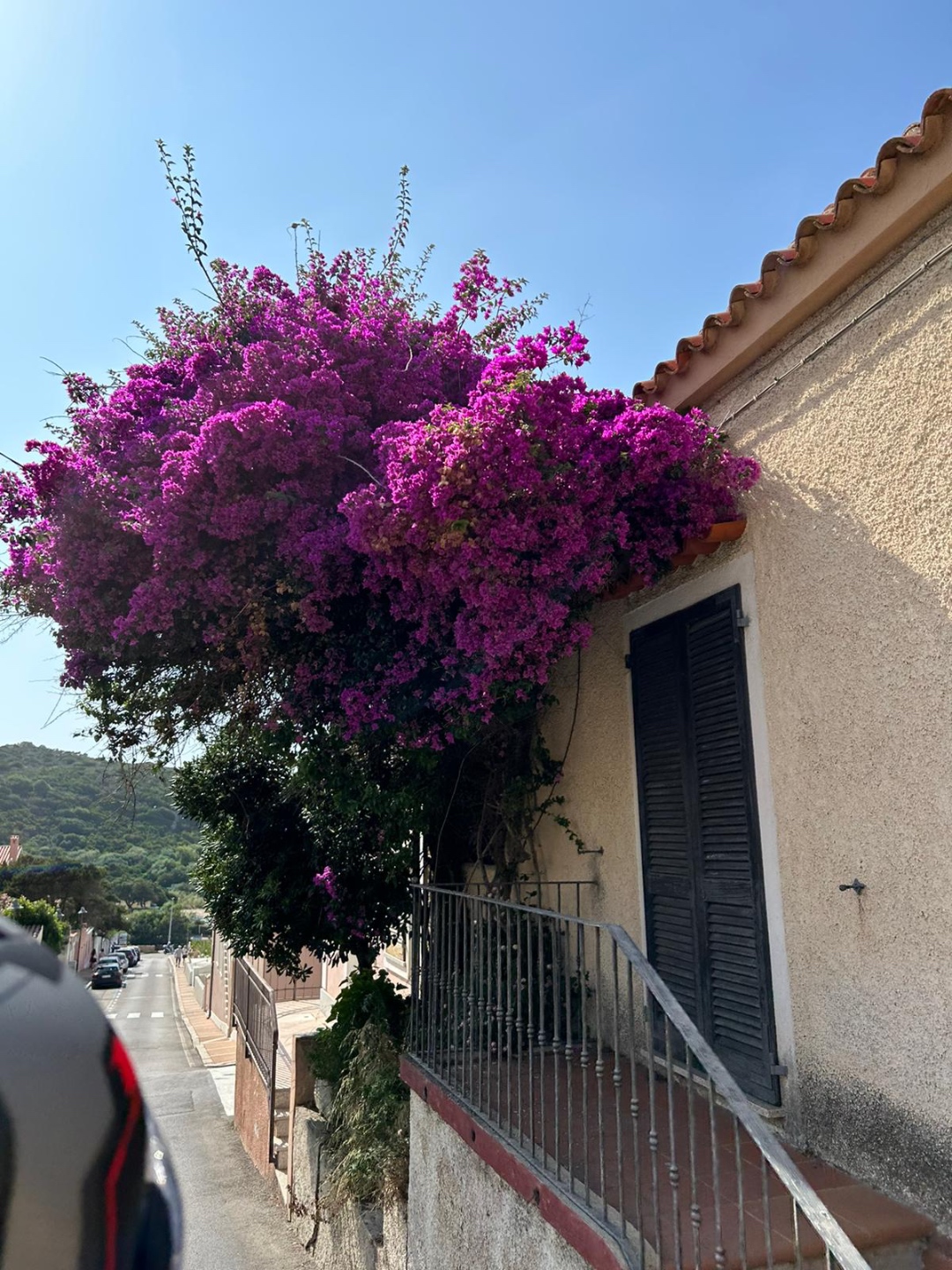
Vivid magenta bougainvillea cascading over a whitewashed stucco wall in a narrow village lane. In Sardinia, every alley seems to bloom — the Mediterranean climate makes flowers as inevitable as the sea breeze.
The Torre di Longonsardo — a 16th-century Spanish watchtower — watches over the beach. Across the narrow Strait of Bonifacio, the mountains of Corsica are visible on clear days. The water here is among the clearest in the Mediterranean.
A fellow traveler and his battle-worn Yamaha Ténéré 700 loaded with Mosko Moto luggage at the ferry dock — the universal look of a long-distance moto adventure well underway. The red Airoh helmet tells its own story.
Kathy and a friend embrace on the infinity terrace as the Mediterranean shimmers behind them, granite sea stacks of the La Maddalena Archipelago rising from the turquoise water. Northern Sardinia at its most spectacular.
A yellow-legged gull claims the infinity pool edge at golden hour — the granite sea stacks of the La Maddalena Archipelago glowing amber in the fading light behind. Some guests have more confidence than others.
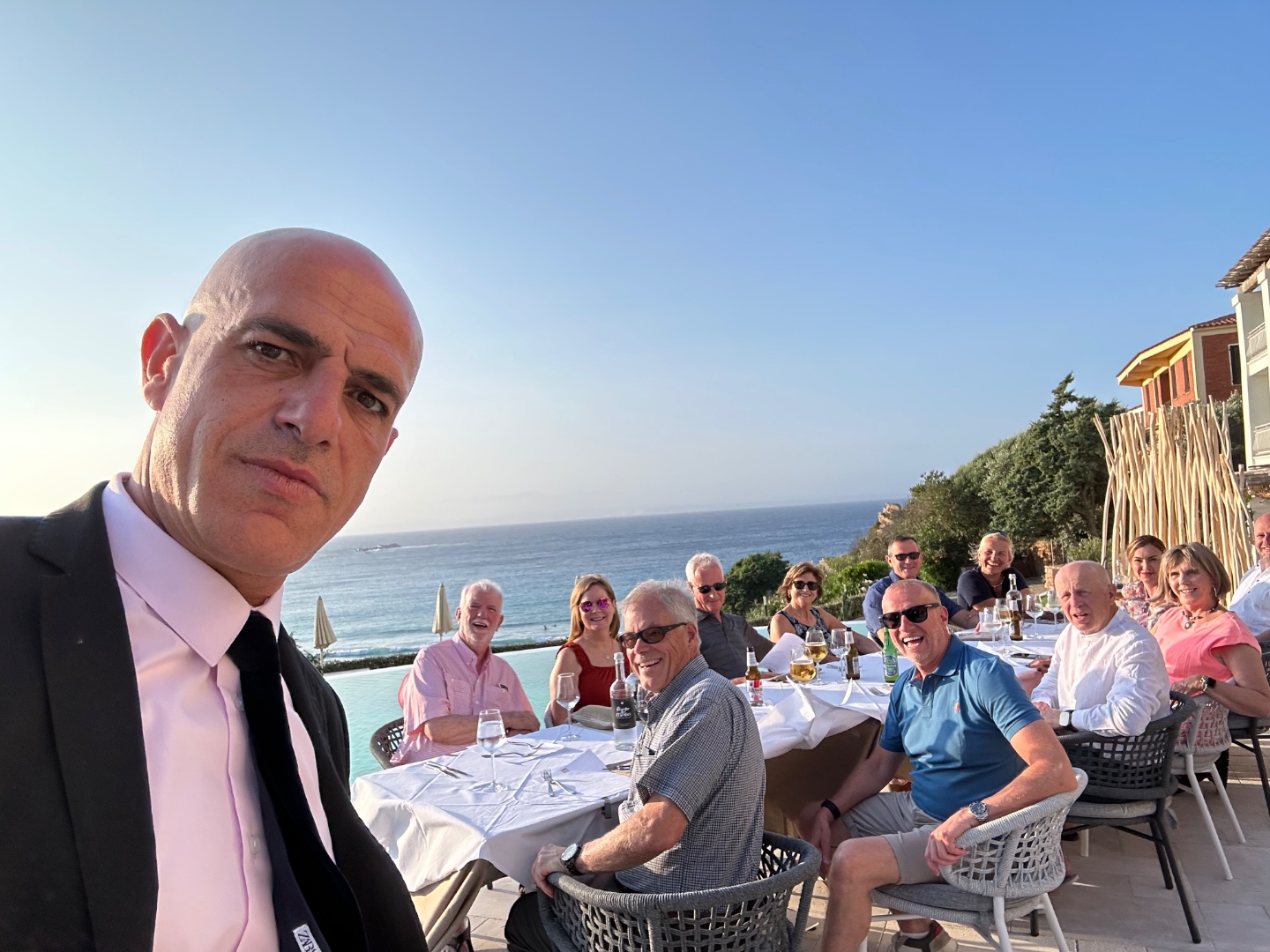
Twelve riders dine on an infinity terrace as the Mediterranean fades to dusk. Sardinia's northern coast is lined with world-class resorts — a fitting reward after a day in the saddle through the island's rugged interior.
The evening's waiter joins the group for a selfie — the universal sign that dinner was a success. Italian hospitality at its finest: formal white-glove service, genuinely warm spirit.
The Edelweiss Bike Travel AMA Alps Challenge and beyond — Munich through the Austrian Alps, into Switzerland via the Furka, Grimsel, and Gotthard passes.
The route map from American Motorcyclist magazine outlines the AMA Alps Challenge: Munich → Innsbruck → Stelvio Pass → Dolomites → back through Austria. One of the most celebrated motorcycle touring routes on earth.
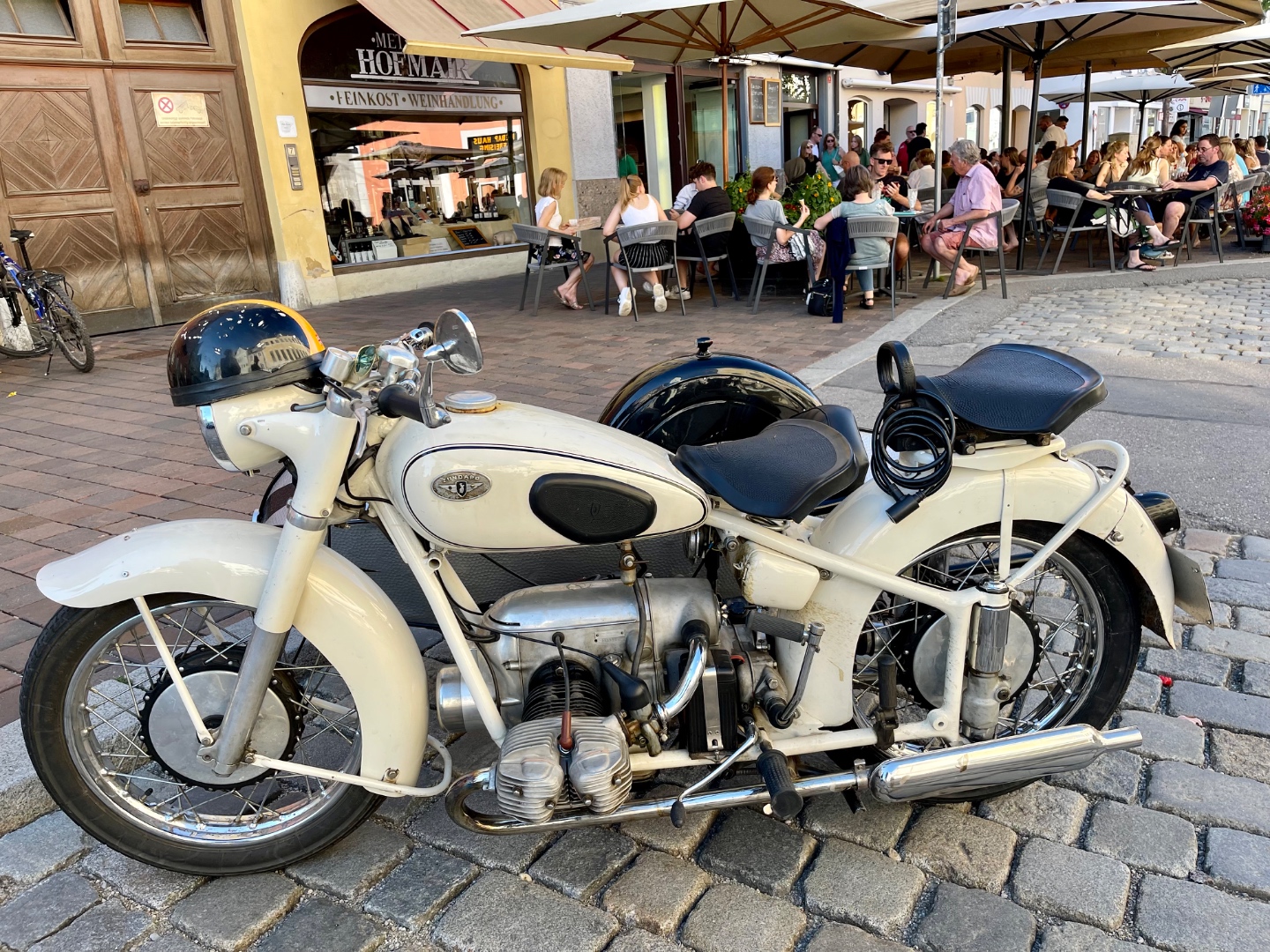
A museum-quality Zündapp KS 601 with sidecar — the classic 1950s German boxer twin — parked outside a Bavarian Feinkost and wine shop. A living reminder of what European motorcycling looked like before the autobahn era.
The timeless ritual of route planning: two riders study the Michelin Austria map over coffee at an outdoor café, mountains rising behind. No GPS algorithm replaces the satisfaction of tracing a route with your finger.
A well-earned café stop in the Austrian Alps — Alpinestars jacket on, coffee in hand, mountains all around. The "Wiener Kultur" umbrella is a cheerful reminder that Viennese café culture travels well into the high country.
A heavily loaded Simson S51 — the beloved East German 50cc moped — at a moped rally in the Austrian Alps. Built in Suhl from 1980 to 2002, the Simson became a cult icon across Central Europe after reunification.
An MZ/Florett moped loaded to the absolute limit — sheepskin seat cover, WWII-style pudding bowl helmet, and enough camping gear for a month. Moped rallies in the Alps attract the most creative, eccentric, and lovable characters in motorcycling.
The Lech valley unfolds below — lush green meadows descending to the valley floor, a winding road threading between farmhouses, and the Arlberg peaks rising on all sides. This valley connects Austria to Switzerland via some of the Alps' most celebrated passes.
The legendary hairpins of the Stelvio Pass — 48 numbered switchbacks climbing to 2,757 meters, consistently voted the world's greatest motorcycle road. Built by the Austrian Empire between 1820 and 1825, it remains a pilgrimage for every serious rider.
An open alpine meadow at the Reschenpass — one of the oldest Alpine crossings, used since Roman times. The submerged church tower of the flooded village of Alt-Graun is visible just over the ridge at the nearby reservoir.
A lemon cheesecake with balsamic reduction — the Alps reward hard riding days with excellent food. The high mountain passes of South Tyrol sit at the confluence of Austrian and Italian culinary traditions.
Sailboats on glacier-fed turquoise water — Lake Silvaplana in the Upper Engadine valley, one of the world's premier windsurfing destinations thanks to the reliable Maloja wind that funnels down the valley every afternoon.
Joe and his riding buddy on a flower-box wall with Lake Silvaplana sparkling behind — a perfect alpine rest stop in the Upper Engadine, elevation 1,800 meters, surrounded by four mountain passes.
A Swiss-registered Ferrari F12berlinetta on an alpine pass — because Switzerland. The same roads that reward motorcyclists reward Italian supercars equally, and the Swiss tend to make the most of both.
Kathy with a geometric polar bear sculpture in a sleek alpine hotel lobby. Andermatt has transformed in recent years from a quiet army garrison town into one of Switzerland's most modern mountain resort destinations.
Three friends perched on a stone bridge wall in one of Switzerland's most photographed alpine valleys. The Goms Valley runs along the upper Rhône, through a string of traditional Alemannic villages virtually unchanged for centuries.
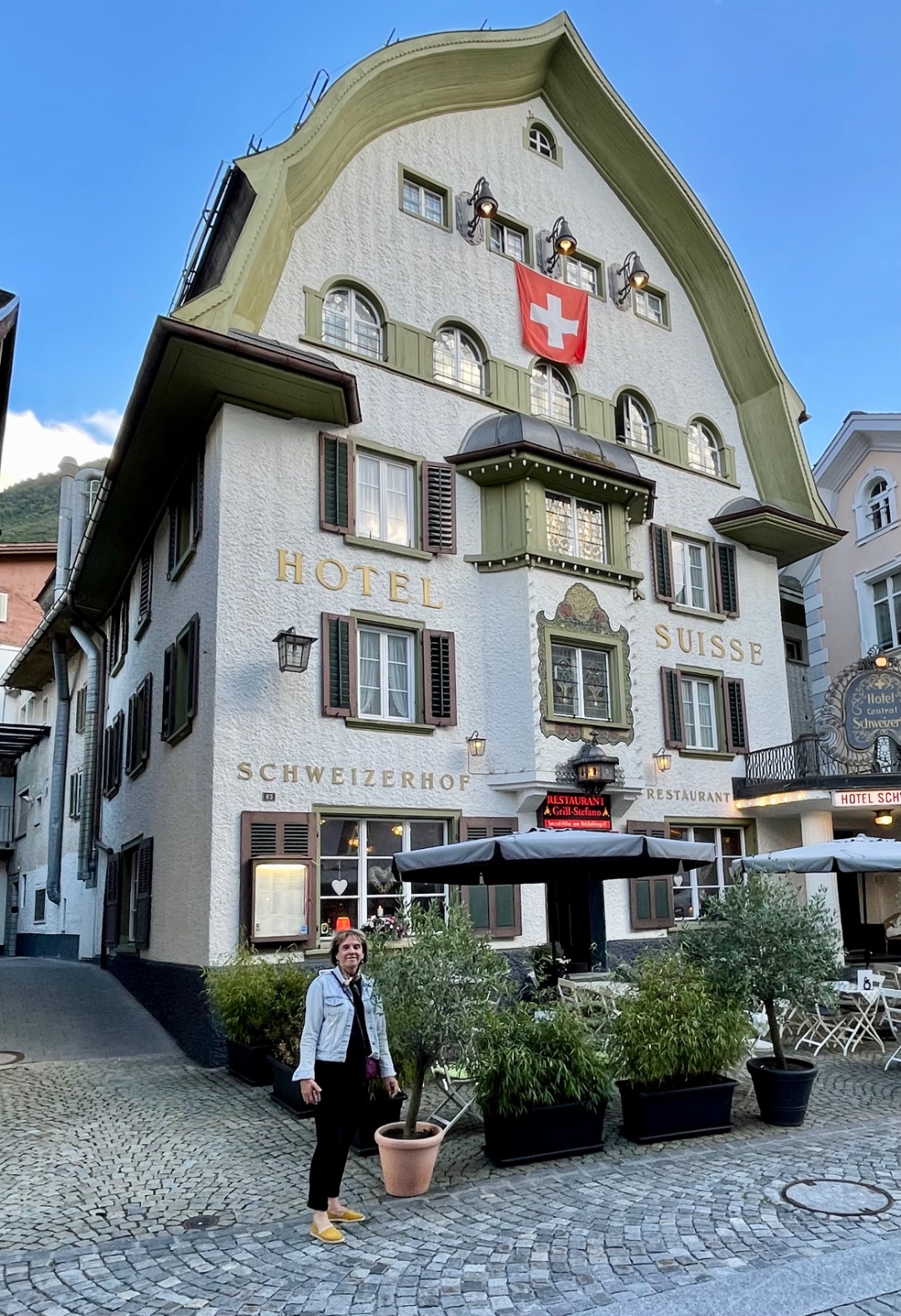
Kathy outside the Hotel Schweizerhof — a name found across Switzerland, from Bern to Lucerne to the alpine villages. The Swiss flag snapping in the mountain wind is its own kind of welcome sign.
Joe triumphant under the Hotel Crown sign — the universal gesture of a rider who has just conquered another great pass. Every hotel sign in the Alps has been earned.
The colossal hairpins of the Furka or Grimsel pass drop into a glacial river valley far below — snowy peaks on all sides. The Furka was made famous by the James Bond film Goldfinger in 1964; the Grimsel is one of the highest paved roads in Switzerland.
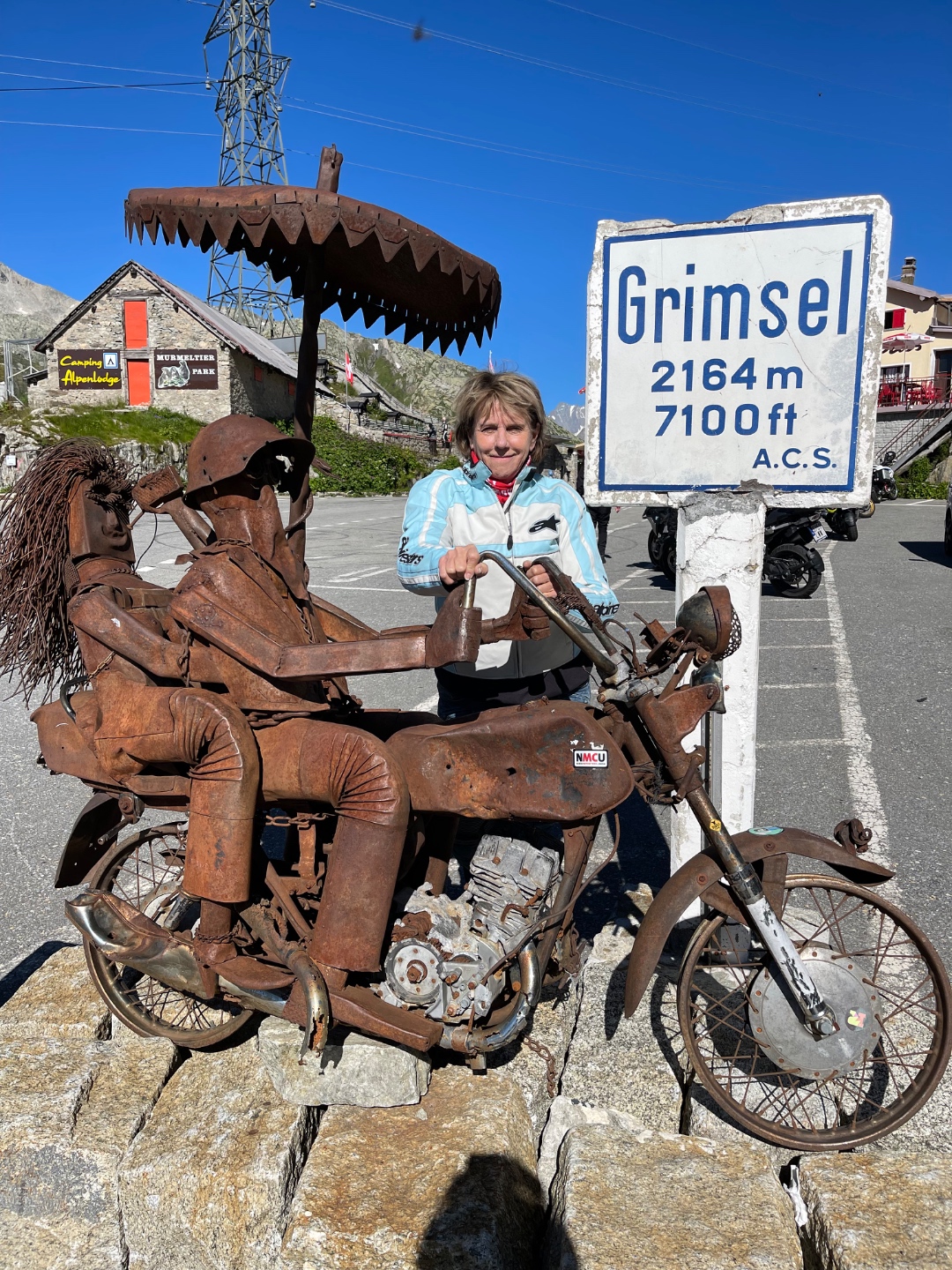
Kathy at the Grimsel Pass summit marker — elevation 2,164 meters, decorated with a rusty iron motorcycle sculpture that captures the spirit of every rider who has reached the top. The Grimsel connects the Bernese Oberland with the Rhône Valley.
The UNESCO World Heritage peaks of northeastern Italy — Cortina d'Ampezzo, Passo Giau, the Cristallo massif, and the towers of the Sella Group.
A traditional chalet and ski lift pylons frame the jagged Dolomite walls as low clouds drift through the valleys. Cortina d'Ampezzo — the "Queen of the Dolomites" — hosted the 1956 Winter Olympics and the 2026 Alpine Ski World Championships.
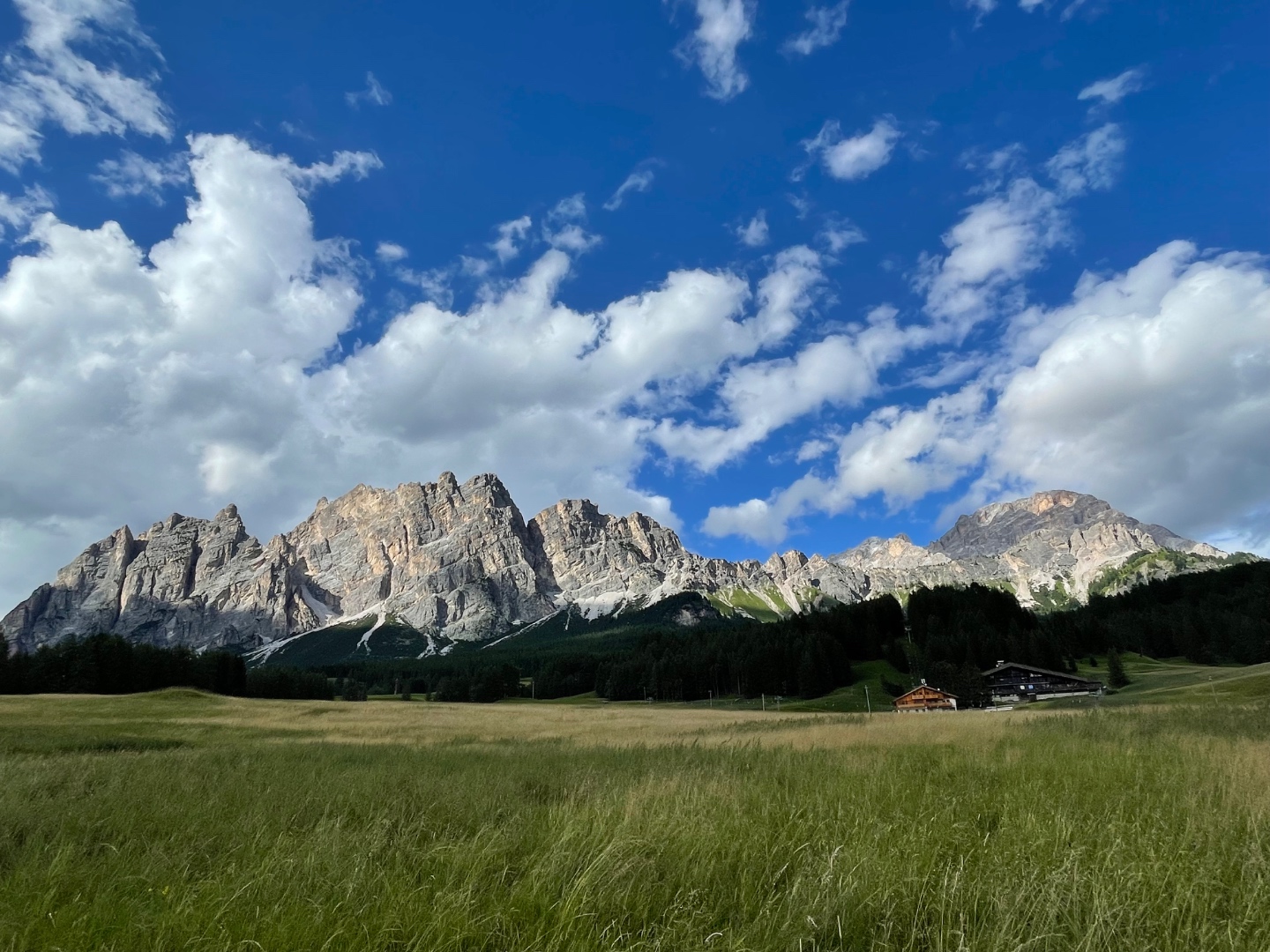
The Cristallo massif (3,221m) towers above an open alpine meadow near Cortina. The pale limestone walls of the Dolomites change color dramatically through the day — from bone white at noon to deep rose at alpenglow.
Golden afternoon light on the Cristallo's pale faces — the name comes from their crystalline appearance in early morning sun. These walls were fiercely contested during the mountain warfare of World War I.
Joe and Kathy at Passo Giau with the dramatic Ra Gusela pinnacle rising directly behind them — one of the most iconic viewpoints in the Dolomites. The pass connects the Ampezzo valley to the Colle Santa Lucia and is frequently used as a backdrop for car and motorcycle advertising.
The full group assembled at Passo Giau — Ra Gusela's spire framing the shot perfectly. At 2,236 meters, the pass delivers 360-degree Dolomite panoramas that justify every kilometer of the climb.
A classic Dolomite church steeple with road signs pointing to Alleghe, Belluno, Cortina d'Ampezzo, and Marmolada — the highest peak in the Dolomites at 3,343m. Every direction from here leads to another stunning pass.
Austria's most spectacular lake districts and alpine roads — from the fairy-tale shores of Hallstatt to the glaciated summit of the Grossglockner High Alpine Road.
The iconic view of Hallstatt — colorful 16th-century houses stacked against a vertical cliff face, their reflections shimmering in the Hallstätter See. A UNESCO World Heritage Site and one of the oldest continuously inhabited settlements in Europe, with salt mines dating back 7,000 years.
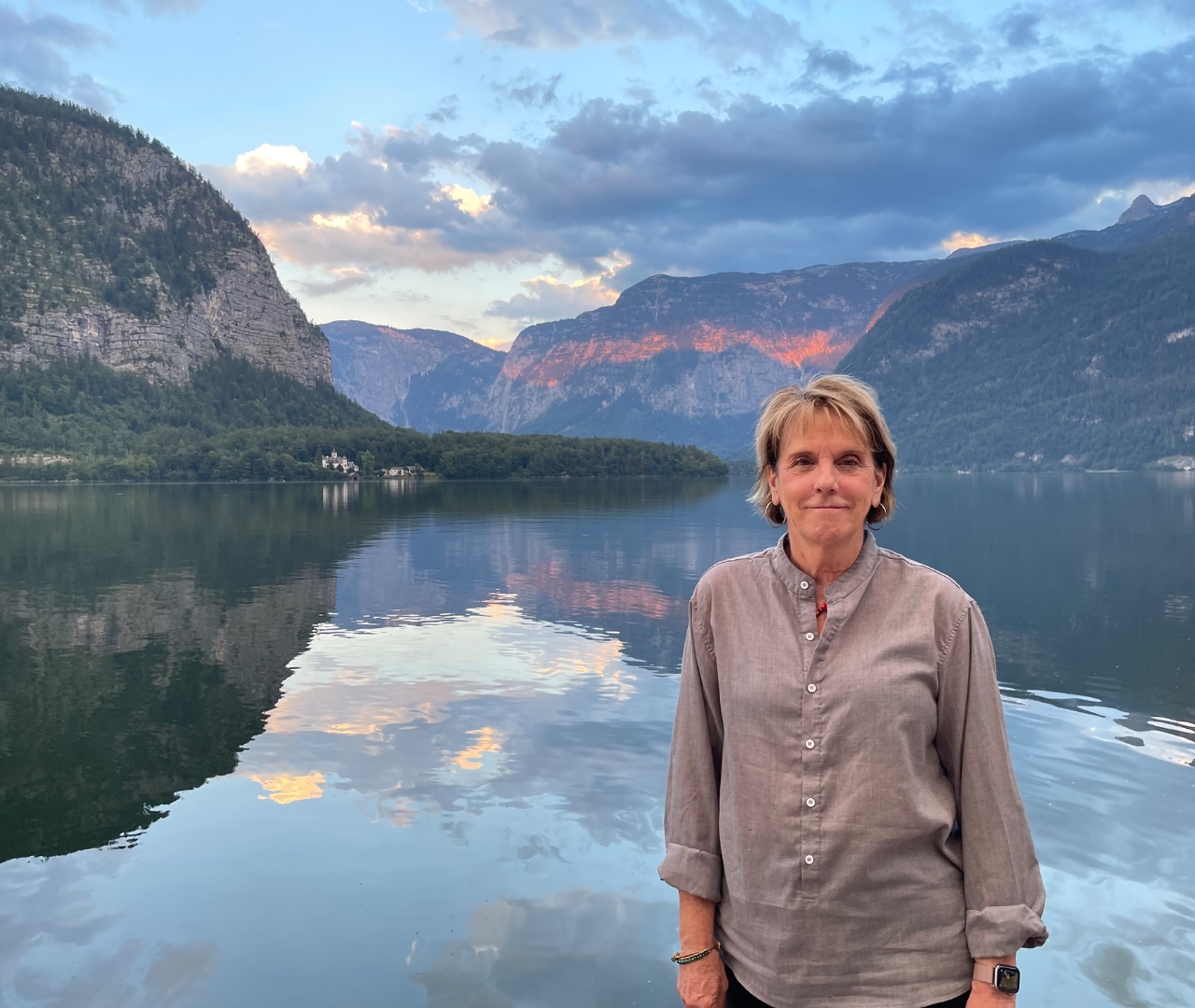
Kathy at the Hallstatt lakefront as alpenglow lights the limestone cliffs behind — the Dachstein massif turning pink and gold in the evening light above the mirror-still water.
Joe and Kathy at dusk on the Hallstatt shore — the village lights beginning to reflect in the deepening water, the Hallstatt-Dachstein cliffs fading into blue behind them.
Eleven riders at a viewpoint on the Grossglockner High Alpine Road — snow-capped peaks of the Hohe Tauern National Park stretching in every direction, Joe kneeling front-and-center in full Red Bull/KiNi race colors. The Grossglockner (3,798m), Austria's highest peak, is visible on clear days from this vantage point.
A quintessential Austrian chalet — three stories of red-railed balconies overflowing with red geraniums, Kathy visible on the top floor enjoying the mountain view. This is the Austria of postcards, and it's entirely real.
Joe and Kathy at the shore of the Zeller See — white hydrangeas and a cypress tree framing a perfect alpine summer moment. Zell am See sits between two major national parks and offers some of Austria's finest riding in every direction.
The Colosseum at sunrise, espresso at a marble bar, gelato in a Ligurian alley, and the Rialto Bridge at golden hour — Italy on its own terms.
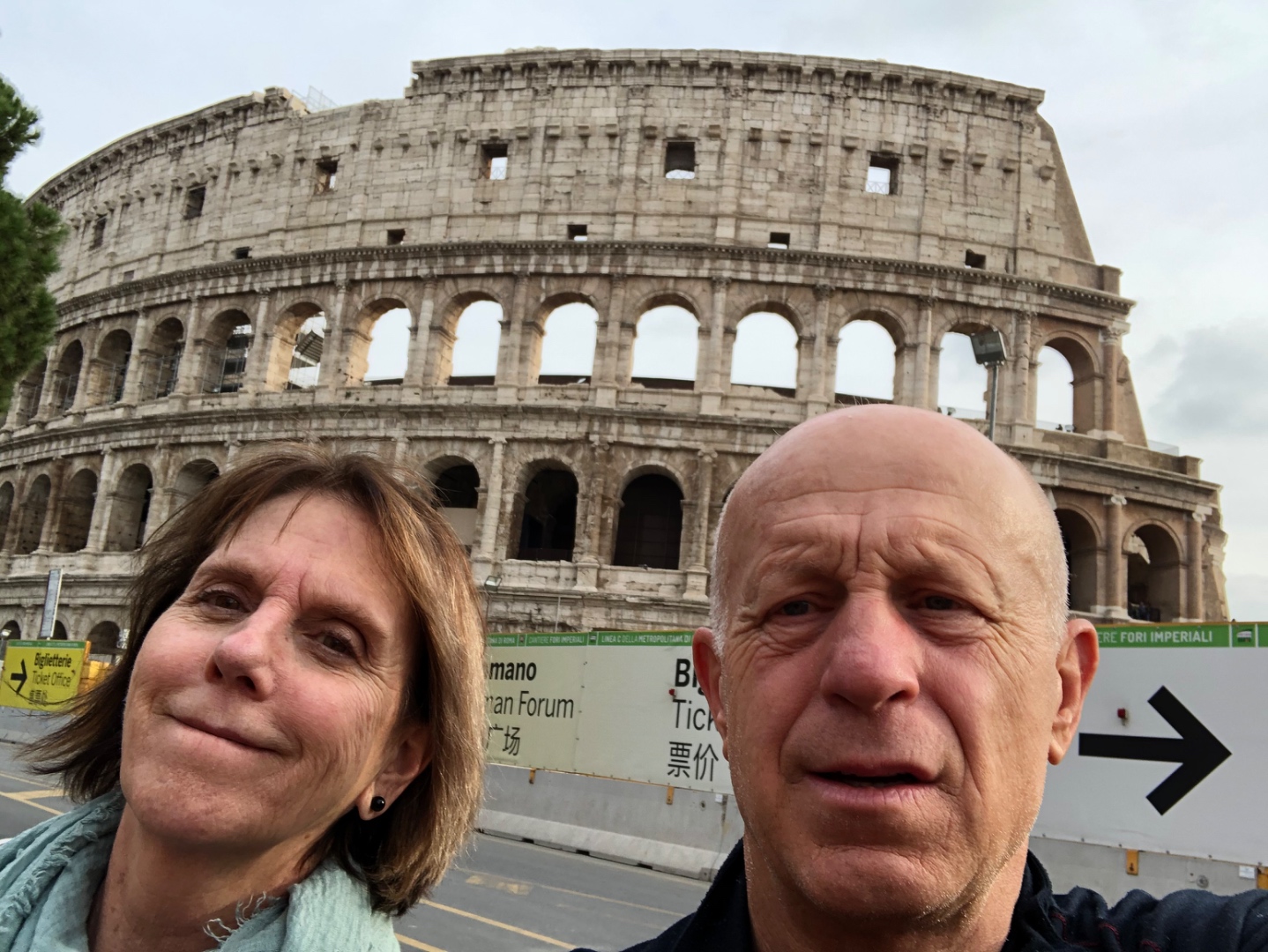
Joe and Kathy in front of the Colosseum — the largest amphitheater ever built, completed in 80 AD under Emperor Titus. At its peak it held 50,000 to 80,000 spectators for gladiatorial contests, animal hunts, and public spectacles.
A perfect cappuccino at a Roman bar — the marble counter, the Baroque-motif branded cup, the crema-topped foam. Romans drink their espresso standing at the bar; sitting down costs extra.
The 135 steps of the Scalinata di Trinità dei Monti rise to the 16th-century church and Egyptian obelisk above — built between 1723 and 1725 and named for the nearby Spanish Embassy to the Holy See.
A sea of orange shirts and glowing accessories at a nighttime Italian festival or flash mob — the kind of spontaneous spectacle that makes wandering Italian city streets after dark so rewarding.
Kathy at the overlook above Riomaggiore — the southernmost of the five Cinque Terre villages, its colorful stacked houses tumbling down the cliff face to a small harbor. The village dates to the 8th century; the terraced vineyards above it are even older.
Manarola's rooftops and medieval bell tower rise above the terraced vineyard hillside. The DOC Sciacchetrà wine produced on these near-vertical slopes — accessible only by hand and monorail — is one of Italy's most labor-intensive wines.
Manarola at dusk under a moody overcast sky — the village clings to the cliff face above its tiny harbor as it has for seven centuries. The Cinque Terre were declared a UNESCO World Heritage Site in 1997.
The striking black-and-white striped Gothic-Ligurian façade of San Giovanni Battista — Monterosso's medieval parish church, built in 1244. The alternating dark serpentine and white marble stripes are a signature of Ligurian Gothic architecture.
A Caffè Molinari espresso, nearly finished — the Italian way of marking a moment between the villages. Molinari has been roasting coffee in Modena since 1904; their cups appear in cafés across northern Italy.
Kathy and a gelato cone of heroic proportions in a Cinque Terre alley — the expression says everything that needs to be said. Italian gelato is made fresh daily with local fruit and is indisputably the world's finest frozen dessert.
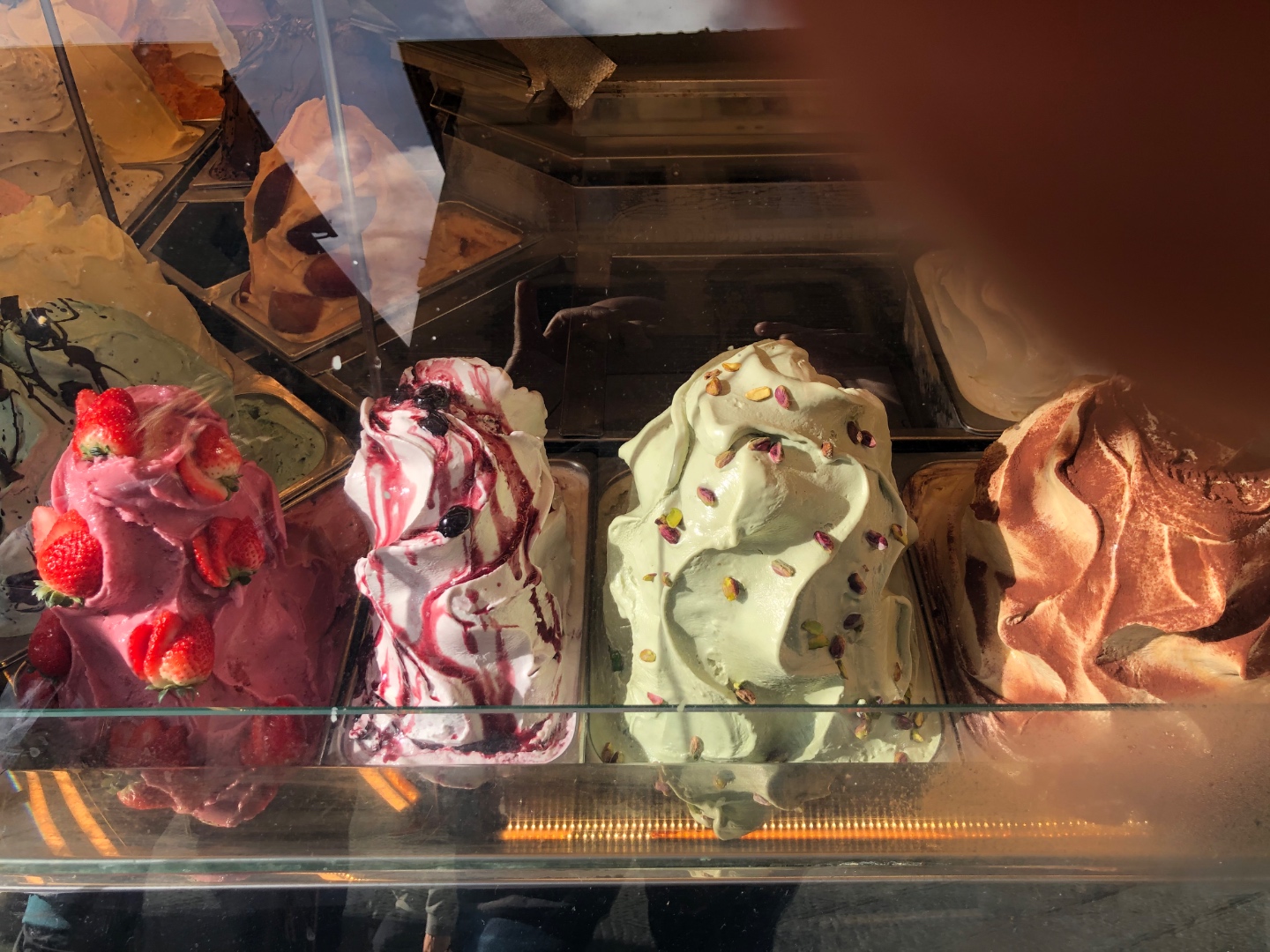
The daily dilemma: strawberry, black cherry, pistachio, or dark chocolate? Cinque Terre gelaterias source their flavors from local Ligurian fruit — the strawberries from Sestri Levante, the lemons from the terraced groves above the villages.
A gondola glides beneath the Rialto Bridge — the oldest of the four bridges spanning the Grand Canal, completed in 1591 after a design competition that Michelangelo, Palladio, and Sansovino all entered and lost. Venice has been sinking approximately 1–2mm per year since the 20th century.
Baroque arcades, Art Nouveau cafés, Warhol exhibitions, and the medieval streets of Český Krumlov — Central Europe's most architecturally extravagant corner.
The main square of Český Krumlov glows in evening light — Baroque facades in pastel pink, green, and cream, a 17th-century Plague Column at center. This UNESCO World Heritage town on the Vltava River has been preserved almost entirely intact since the Renaissance.
A white horse-drawn carriage pauses outside a café terrace in bloom — the coachman in top hat, geraniums everywhere, Staropramen beer on the umbrella. Prague's tourist quarter still operates carriages through its Baroque quarters year-round.
Prague's Vinohrady neighborhood — one of the city's most stylish residential districts — hosts this deliberately provocative smash burger spot. The "Vinohradský Pivovar" brewery umbrella on the terrace is more refined; the sign is pure Czech humor.
Six colorways of Warhol's iconic Marilyn Monroe screenprint series — created in 1967, two years after her death. Warhol made Monroe the most reproduced face in art history, and Prague's gallery scene has embraced Pop Art with particular enthusiasm.
The "Gold Marilyn" triptych — bold red and gold geometric backgrounds fragmenting Monroe's face across three panels. Warhol's Marilyn prints are among the most valuable screenprints ever sold, with single examples exceeding $195 million at auction.
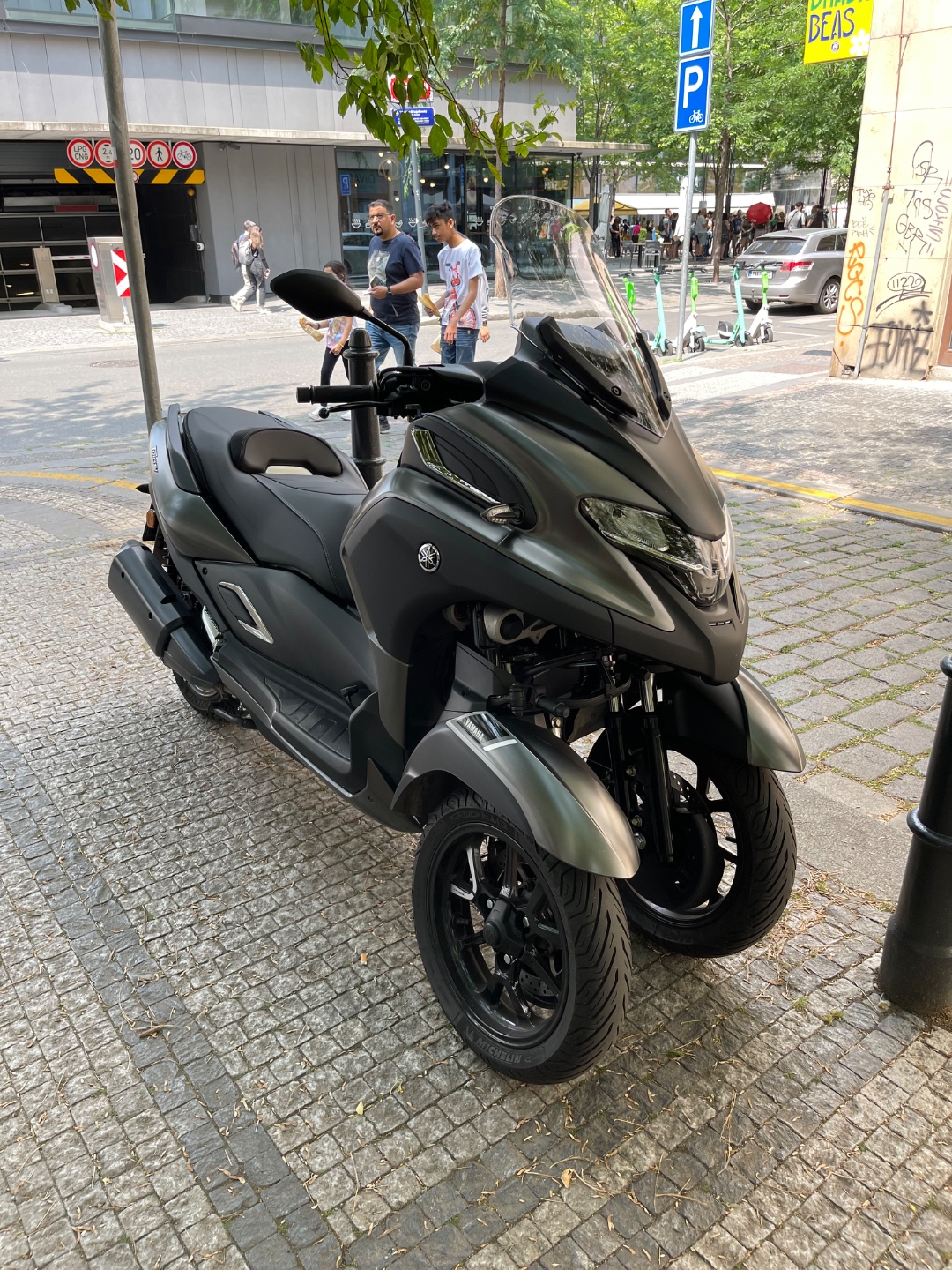
A Yamaha Tricity 300 — the leaning three-wheel scooter — on Prague's cobblestones. The Tricity's twin front wheels provide motorcycle-style cornering with significantly enhanced stability on the city's uneven historical paving.
An Einstein portrait t-shirt in the Café Louvre window — a nod to one of the café's most famous regulars. Albert Einstein was a professor in Prague from 1911 to 1912 and frequented the Louvre for its billiard tables and intellectual company.
Kathy outside Café Louvre — established 1902 on Národní třída, one of Prague's grandest boulevards. Franz Kafka, Albert Einstein, and Max Brod all sat in these rooms. The billiard hall upstairs is still in operation, unchanged for over a century.
Kathy stands beneath David Černý's Dead Horse — St. Wenceslas (patron saint of Bohemia) astride a dead, upside-down horse, suspended from the Art Nouveau dome of the Lucerna Palace arcade. Installed in 1999 as a sardonic counterpoint to the heroic equestrian statue of Wenceslas in the square above.
Joe and Kathy in the ornate interior of Prague's great concert hall — gilded plasterwork, Corinthian columns, and Art Nouveau grandeur. The Smetana Hall in the Municipal House is home to the Prague Spring International Music Festival.
The City of Light from the rooftops of Montmartre to the Trocadéro — and the inspiration behind a legendary rally that defined adventure riding for a generation.
The original Paris–Dakar route: from Paris south through France, across the Sahara via Algiers, Tamanrasset, and Agadez, through Mali and Niger, ending in Dakar, Senegal. The legendary off-road endurance race — inspiration behind countless adventure riders' dreams — ran this transcontinental route from 1979 until security concerns moved it to South America in 2009.
The white travertine domes of Sacré-Cœur rise above a sea of Paris zinc rooftops on a clear spring morning. Construction began in 1875 as a statement of national atonement after the Franco-Prussian War; the basilica was consecrated in 1919. The view from the steps remains one of the finest in Paris.
The classic Trocadéro shot — Joe and Kathy with the Eiffel Tower perfectly framed behind them. Gustave Eiffel's iron lattice tower was built as the entrance arch for the 1889 World's Fair and was originally intended to be dismantled after 20 years. Paris reconsidered.
A holiday voyage on the Danube — Budapest, Vienna, Salzburg, and Passau dressed in Christmas markets and candlelight.
Joe and Kathy with the ship's captain beside a tall Christmas tree in the Viking longship's lobby — a holiday sailing on the Danube through some of Central Europe's most beloved Christmas market cities. Viking's Danube Waltz route connects Budapest to Passau through Vienna, Melk, and Salzburg.